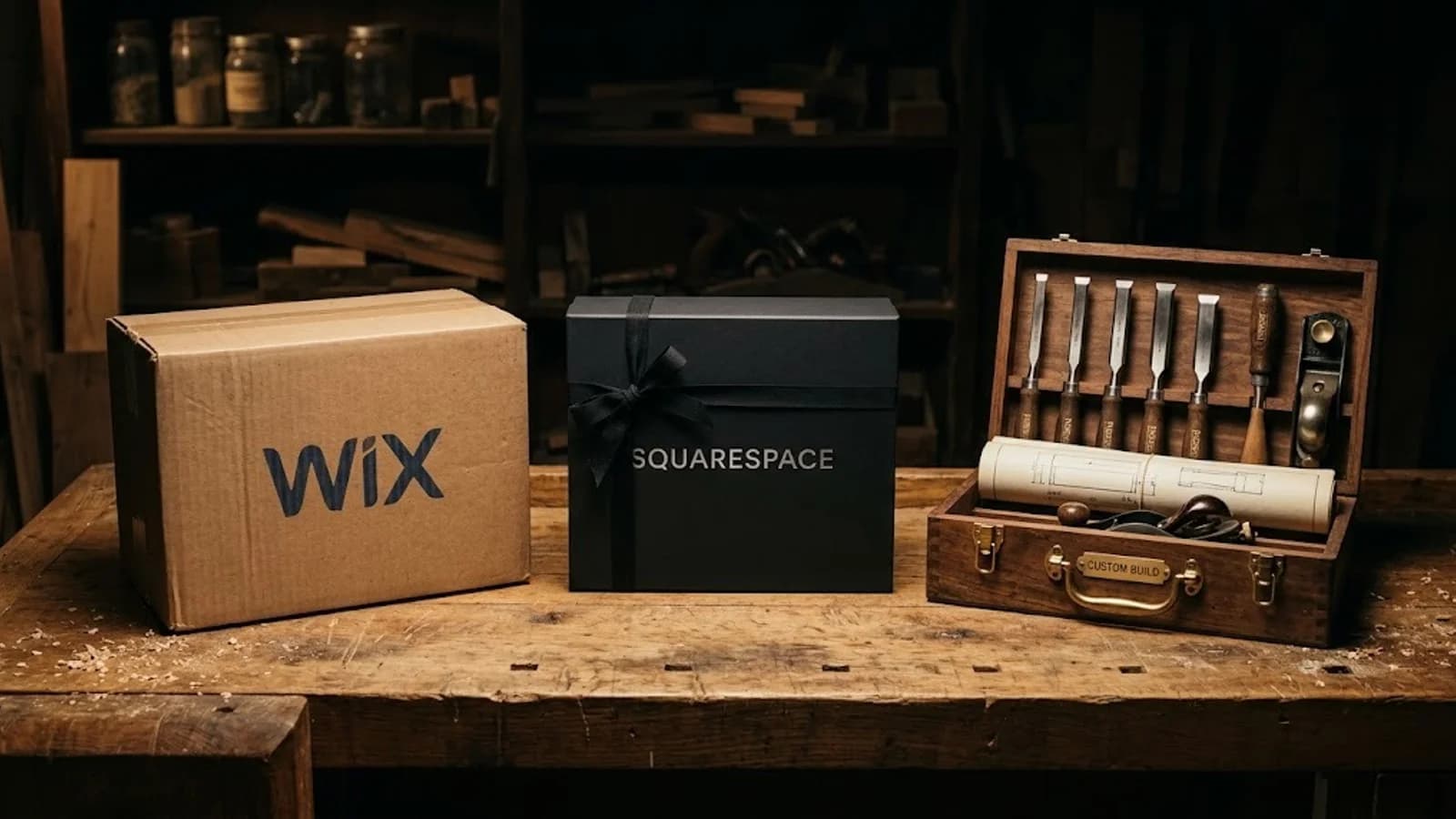
There is a version of this article on every SEO blog on the internet. Most of them are wrong in the same way. They pretend the answer is universal, they cite feature checklists that were true two years ago, and they end with a line like "it depends on your needs." That is not a decision framework. It is a shrug.
This one is different, because this is the answer we actually give clients when they ask. Some walk in wanting a Wix site. Some walk in wanting a custom Next.js build because a friend told them to. A useful number of them leave with the opposite of what they came in for, and every one of those conversations turns on the same handful of tradeoffs.
Here is the honest version.
The thirty-second answer
If the site is a five-page brochure for a service business, the team maintains it themselves, and there is no near-term plan to bolt on anything more complicated than a contact form, pick Squarespace. It has the cleanest defaults, the smallest chance of the site becoming visually chaotic six months in, and the best out-of-the-box performance among the mainstream builders.
If the site needs storefront-style flexibility on the cheap, if the team is comfortable dragging blocks around and does not mind an occasional performance hit, and if there are third-party integrations the site needs to wear that Squarespace does not natively cover, pick Wix. It is the more permissive of the two, for better and worse.
If the site is a revenue engine, if organic search is a primary acquisition channel, if the business plans to layer on gated content, custom booking, calculators, a client portal, or bespoke integrations, or if the business is being valued as an asset inside the next five years, build custom. Almost always on Next.js. Almost always hosted on Vercel or a comparable edge platform.
Everything below is the long version of that paragraph.
What each option actually is in 2026
Wix is a SaaS website builder that has, over the last three product cycles, quietly rebuilt its rendering pipeline to be competitive with modern static site output. Wix Studio, its more designer-facing surface, ships a lot of the responsive controls, CSS grid parity, and animation tooling that agencies used to leave the platform to get. Under the hood it still runs on Wix's proprietary application platform, which means the business does not own the site in any portable sense.
Squarespace is a SaaS website builder with an opinionated design system, a smaller feature surface than Wix, and a stronger default aesthetic. The 7.1 platform is now the only Squarespace worth discussing. Fluid Engine is Squarespace's newer editor, which loosens the grid constraint that older templates enforced. Squarespace also owns Acuity Scheduling, Unfold, and a handful of other adjacent products, which matters if the business needs booking, video, or lightweight commerce alongside the site.
Custom-built is a broad label. In practice, what most agencies mean when they say "custom" in 2026 is a Next.js application deployed on Vercel, with an MDX-based or headless CMS content layer, edge caching, and JSON-LD structured data baked in. Sometimes it is Astro, Remix, or SvelteKit instead. The distinction between framework and platform matters less than the distinction between a proprietary builder and a codebase the business owns.
There is a fourth option we should name and set aside: WordPress. WordPress still runs a plurality of the internet, and for content-heavy publications with dedicated editorial teams and existing plugin dependencies, it remains a defensible choice. For a small business standing up a marketing site today, WordPress is almost never the right pick anymore. The maintenance surface is too large and the security posture too fragile for the value returned.
The speed conversation
Google confirmed years ago that page experience is a real ranking signal, and in 2026 the specific metric that separates ranking sites from ranked-out ones is Interaction to Next Paint (INP). The target is 200 milliseconds at the 75th percentile of user visits. Sites that miss it lose ground on both Google organic and on AI answer engines that quietly weigh the same underlying signals when picking pages to cite.
Here is the honest state of play across platforms:
- Wix ships a lot of JavaScript by default. Wix Studio sites, well-built, can pass Core Web Vitals cleanly. Legacy Wix Editor sites often do not. The variance across Wix sites is enormous, which means "Wix is slow" is technically wrong but "the average Wix site is slow" is usually right.
- Squarespace 7.1 with Fluid Engine ships considerably lighter templates. Most Squarespace sites pass Core Web Vitals with a competent template choice and reasonable image discipline. INP is where Squarespace still loses points on template-heavy pages with a lot of interactivity.
- Custom Next.js on Vercel is where you find sites that pass Core Web Vitals with real numbers to spare. Server-side rendering, edge caching, image optimization, streaming, and font strategy are all handled by the framework instead of by the site owner. This is where the "custom is faster" claim comes from, and it is one of the few places where the claim is genuinely universal rather than contextual.
The gap matters more in 2026 than it did in 2022 because AI search engines cite fewer pages per query than traditional search returns per query. Being fast is no longer a tie-breaker among ten links. It is an entry ticket to a shorter list.
The SEO conversation
There are two audiences to satisfy in 2026: Google, and the model behind whichever answer engine your customers use before they get to Google. Both weigh similar signals, but they read pages differently.
Google's checklist is well-known: semantic HTML, correct heading structure, editable meta and Open Graph tags, XML sitemaps, canonical tags, structured data, image alt text, internal linking, and content that reflects genuine expertise. All three platforms can pass this checklist. Squarespace's defaults are the cleanest. Wix's controls are the most granular. Custom builds have no defaults because the developer sets them, which means they are either the best or the worst on the list depending on who built the site.
The generative engine side of the conversation is younger. Answer engines and AI overviews cite sources by picking pages that are easy to parse, well-structured, unambiguous about authorship, and rich in the specific claim the user asked about. The winners here tend to have:
- Clean semantic HTML with unambiguous heading hierarchy
- JSON-LD structured data, especially Article, FAQPage, and Person
- Author bylines that link to the author's LinkedIn or other verifiable identity
- Dates that are visible in the DOM, not just in metadata
- Content that answers the specific question in the first few sentences after the H2
Both builders will let you approximate this. A custom build lets you engineer for it. That difference shows up in citation odds, not in ranking positions, and citation odds are where AI search traffic is going to be won or lost for the next several years.
The total cost of ownership over three years
This is the calculation most buyer's guides skip. Here is a realistic three-year TCO for a small business marketing site, in US dollars, assuming honest inputs.
Wix (Business Elite plan) at roughly USD 45 per month plus domain plus one or two premium apps lands around USD 1,900 to USD 2,300 over three years. No build cost if the owner assembles it. Add USD 500 to USD 3,000 for a professional designer to lay it out, if the owner does not want to.
Squarespace (Business plan) at roughly USD 23 per month plus domain plus a scheduling add-on lands around USD 1,000 to USD 1,400 over three years. Add USD 500 to USD 3,000 for a designer, same as Wix. Squarespace comes out cheaper in this comparison unless the business really needs Wix's extended app market.
Custom Next.js on Vercel is a one-time build plus a small ongoing hosting bill. Build fees scale with scope: a single landing page can start in the low three-figures, typical multi-page marketing sites land in the low-to-mid four-figures, and complex builds with custom integrations, portals, or e-commerce go higher. Hosting on Vercel's Pro tier is USD 20 per month, or USD 720 over three years. A domain is another USD 40 to USD 60 over three years.
The three-year math is why we push back on the assumption that custom is automatically more expensive. It usually is in year one. It usually is not by year three, especially once the business has grown into the site and would otherwise be paying to work around the builder's limitations. The break-even math is closer than most agencies advertise, because most agencies do not have to explain it to CFOs. We do.
What each option quietly costs
Every platform costs more than the sticker price, and every platform's hidden costs live in a different place.
Wix's hidden cost is design debt. The permissiveness of the builder means most sites drift visually over the first eighteen months as the owner adds pages, sections, and third-party widgets. What was launched as a clean four-page site often turns into a nine-page site with three different button styles by month twelve. Rebuild time is real time.
Squarespace's hidden cost is the ceiling. The moment a small business needs anything beyond what Squarespace's templates support, the workaround is either a code injection block (which defeats the purpose of picking a builder) or a decision to leave. Leaving Squarespace is more expensive than leaving Wix, because Squarespace's content structure is harder to export cleanly.
Custom-built's hidden cost is dependency on the builder. If the agency that built the site disappears or the internal developer leaves, the business needs a new team who can read the codebase. This is a real cost, and it is why we insist on plain, well-documented codebases with no bespoke framework layers on top. A well-built Next.js site can be picked up by any competent React developer. A bespoke framework built on top of Next.js cannot.
The AI and integrations question
This is where the platform gap widens in 2026. Every small business is now, on some quiet timeline, going to want to attach an AI feature to its site. A chatbot for lead qualification. A calculator that uses a model to score an incoming inquiry. A content pipeline that drafts blog posts from a briefing form. A backend workflow that pulls a customer's information from a CRM, enriches it with a language model, and returns a personalised email or estimate.
Wix offers an AI website builder and a growing set of AI-adjacent features inside its own ecosystem. They are useful for standing something up. They are not the same as being able to wire a model-agnostic frontier AI call into a site's backend on your own terms, through a gateway that lets you swap providers and control cost. Wix's integration model is closed by design.
Squarespace offers less on the AI feature side and about the same openness as Wix on the integration side. The path to custom AI features on a Squarespace site runs through a third-party embed or a rebuild.
Custom-built treats the AI feature as native. It is a serverless function on the same platform as the site, deployed alongside the codebase, with observability, cost control, and provider fallback built in. The AI Gateway pattern that has become standard on modern edge platforms in 2026 exists to solve this problem, and it exists on custom builds by default.
If AI is going to be part of the business's roadmap inside the next three years, this is the tie-breaker.
Migration paths, honestly
The most common migration is Wix or Squarespace to custom, in that order. It looks like this:
- Audit the existing URLs and content. Preserve URL structure for anything currently ranking. Add server-side redirects for anything moving.
- Export content to a portable format. For most marketing sites, that means Markdown or MDX files with frontmatter, or a headless CMS if the client needs a visual editor.
- Rebuild the design against the new platform's strengths instead of copying the old layout pixel-for-pixel. This is the mistake most agencies make on migration jobs: they treat the rebuild as a port instead of a redesign, and the client ends up paying custom prices for a Squarespace-shaped result.
- Migrate imagery with modern format conversion. WebP or AVIF instead of JPEG or PNG. Correct dimensions instead of upscaling.
- Rebuild structured data. Most Squarespace and Wix sites are missing at least half the JSON-LD they should be shipping.
- Set up analytics, search console, and IndexNow submissions on the new domain. Fire the submission the day the new site is live so search engines re-crawl inside 48 hours instead of the six-to-eight-week default.
A well-scoped migration takes four to eight weeks. A rushed one shows.
Where each platform actually wins
Wix wins when the business needs the widest possible feature surface at builder prices. Restaurants that need booking, ordering, a menu manager, a loyalty program, and a marketing site under one roof. Small e-commerce operations that would otherwise pay Shopify's higher plan tiers. Creators who want a full app suite plus a website plus a scheduling tool without hiring anyone.
Squarespace wins when the business is design-forward, publishes visually, and does not need a lot of custom logic. Photographers, wedding planners, boutique consultants, small hospitality brands. The Squarespace default aesthetic is a real asset for businesses whose customers judge them on visual polish.
Custom-built wins when the site is either a revenue engine, a piece of software with a marketing surface on it, or an asset in a business that will eventually be valued or sold. It also wins for businesses that are competing on organic search as a primary channel, because the Core Web Vitals and structured-data ceiling on a builder is real and the ceiling on a custom build is not.
We built a heritage foodservice distributor's site earlier this year on Next.js after a two-year period where the business had disappeared from its own front door. The choice to go custom rather than reach for a builder was not about capability. Squarespace could have shipped that site. It was about the fact that the business needed to layer product catalog logic, vendor pages, ordering-form integration, and a printable brand kit onto the same domain, and the total three-year cost of doing all of that on a builder was higher than the custom build. That is the calculation, honestly done.
What actually matters in 2026
Three things are more load-bearing than they were the last time you read a post like this.
Interaction to Next Paint (INP). Replaced First Input Delay as a Core Web Vital in March 2024. The 200-millisecond threshold at p75 is now the working target. Sites that miss it lose ground.
AI Overviews and answer engine citations. Traditional search traffic is not disappearing, but a growing share of high-intent queries end at an answer without a click-through. Being one of the sources cited inside the answer is now a distinct outcome to design for. Structured data, clear authorship, and semantic HTML are the levers.
Content velocity. Search and answer engines both reward sites that publish regularly and update older pages. This is where the CMS choice starts to matter more than the platform choice. A builder with a bad publishing workflow is worse than a custom site with a good one, and vice versa.
Feature checklists from 2022 do not decide this anymore. These three do.
The decision framework we actually use
If you want to make the platform choice quickly, this is the sequence.
- Is the site going to touch money? E-commerce, gated subscription, booking, or lead generation for high-ticket services. If yes, favour custom or Squarespace. If it is high-volume commerce specifically, favour Shopify over Wix.
- Is organic search a primary acquisition channel? If yes, favour custom. If no, either builder is fine.
- Is there any custom logic in the eighteen-month roadmap? Calculators, portals, integrations, AI features, custom workflows. If yes, favour custom.
- Who is going to maintain the site day-to-day? If the owner or a non-technical staff member, favour a builder or a custom site with a headless CMS. If a technical team or an agency retainer, either works.
- Is the business being valued or sold inside five years? If yes, favour custom. A codebase the business owns is an asset. A SaaS subscription is not.
Answer those five, and the platform picks itself in almost every case we see. Where it does not, the tie-breaker is usually the AI question in section 8 above.
What we do at Sapere Digital
Our default stack is Next.js on Vercel, MDX for content, and JSON-LD structured data baked into every page from day one. We do not force it onto every project. If a client walks in with a five-page brochure requirement, no growth ambition, and a preference for editing the site themselves without touching code, we will tell them to buy Squarespace and spend the money they saved on better photography.
If the site is going to earn its keep, if it needs to survive contact with a P&L, or if it is going to carry the business's operating history into the next decade, we build it properly, on a codebase the business owns, against the specific outcome the business is trying to reach.
If you are in the middle of this decision, tell us what the site is for and what the business needs it to do in three years. We will tell you honestly which of the three options fits, and we will say so even if the answer is that you should not hire us.